
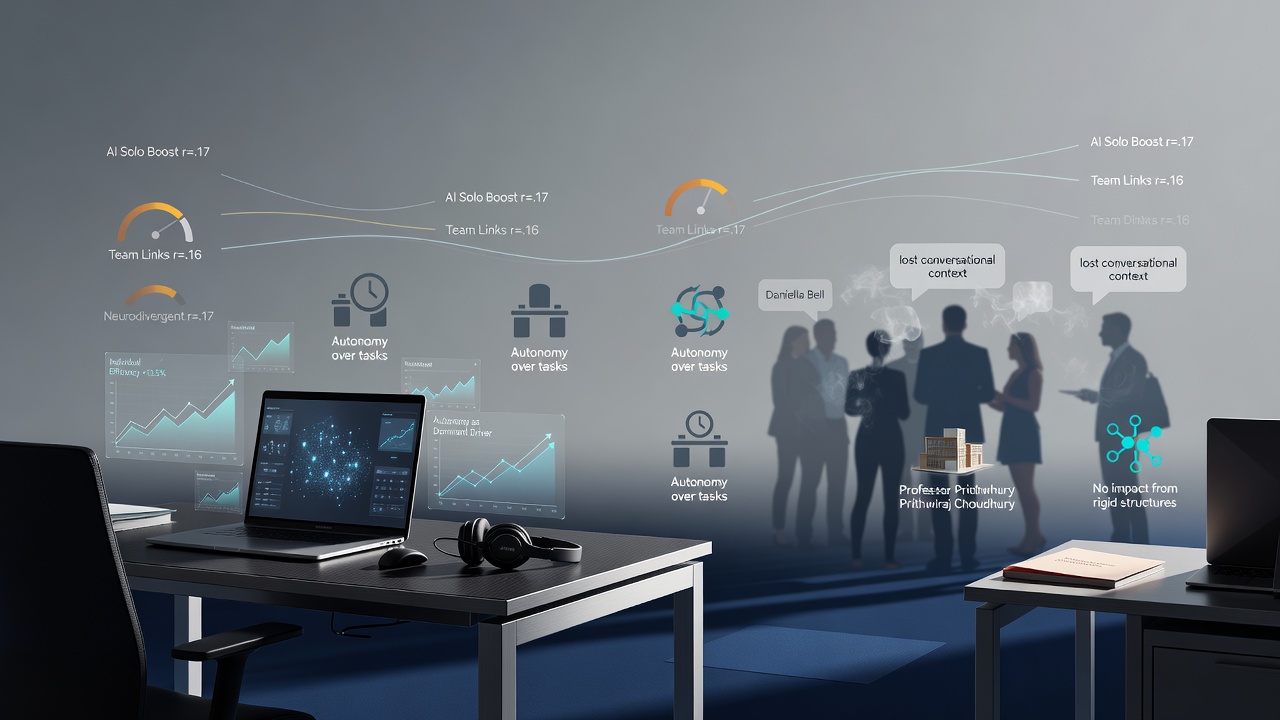
New longitudinal research shows artificial intelligence is making individual workers more efficient, but those gains are not reliably carrying over to team or organizational performance. The 2026 Workstyle Monitor, sponsored by communications-equipment maker Jabra and developed with King's College London, finds that autonomy over how work gets done-not where employees sit-is the stronger driver of productivity and wellbeing.
What the data shows
The study, based on 1,058 respondents weighted toward UK-based professional and managerial knowledge workers, found that technology-related factors explain 13.5% of variation in individual productivity but only 8.9% of variation in team productivity. AI use correlates modestly with workers finding better methods (r=.23), while its links to individual productivity (r=.17) and team productivity (r=.16) are notably weaker. Researchers conclude that efficiency gained through AI tools only becomes a business benefit when employees have the autonomy to redirect that freed-up capacity toward deeper thinking or problem-solving, rather than simply producing more routine output.
Context gets lost between people
Daniella Bell, Future of Work Research Lead at Jabra, points to a structural gap: much of the reasoning behind decisions, meeting caveats and customer insights exists only in conversation and disappears once the exchange ends. Because AI systems can only act on the context they can access, undocumented knowledge limits how far individual AI gains can scale into team-wide benefits. Professor Prithwiraj Choudhury of the London School of Economics notes that AI increasingly lets one person do work that once required several specialists, but cautions that organizations must redesign workflows so this added capability compounds when people collaborate, rather than staying siloed.
Office location matters less than control over tasks
For employers weighing return-to-office mandates, the research found that physical location has little bearing on whether collaboration succeeds, and the balance between digital and in-person interaction shows no measurable relationship with team productivity. Trust in workplace technology, however, correlates moderately with trust among teammates (r=.40) and explains an added 2.5% of variation in team trust. When researchers compared factors like device use, location flexibility and autonomy, only autonomy remained significantly linked to employee vitality-driven specifically by control over how tasks are shaped, not simply the choice of workplace.
Uneven experience across the workforce
The study also found that neurodivergent and disabled employees sustain productivity levels close to their peers despite reporting markedly lower vitality scores (4.12 and 4.21, respectively, versus 4.82 and 4.89 for comparison groups) and reduced autonomy, inclusion and trust in workplace technology. Women reported slightly lower vitality than men (4.67 versus 4.87). The authors suggest this indicates comparable output is often achieved within less supportive conditions, and argue AI's adaptive features could be used to offer more personalized ways of working rather than defaulting to a one-size-fits-all design.