
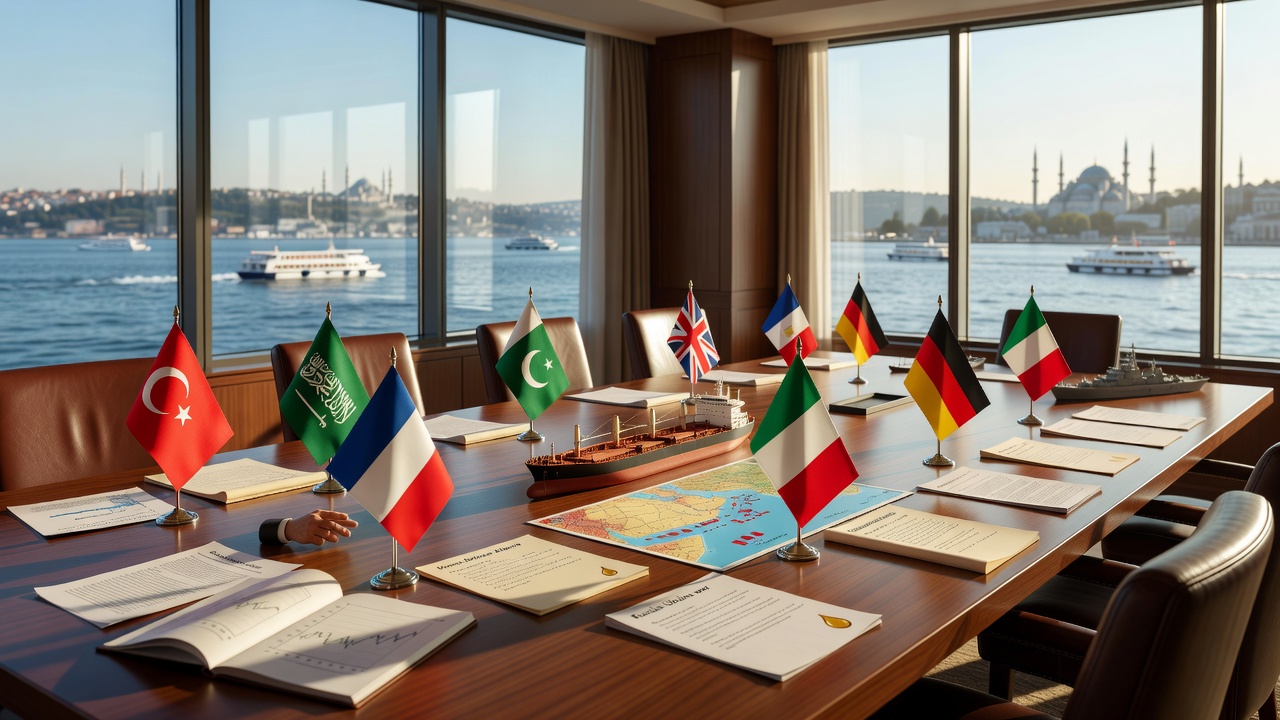
Foreign ministers from eight countries held their first joint session in Istanbul on Friday, launching an expanded diplomatic format aimed at easing Middle East tensions, including the blocked Strait of Hormuz and attacks on Saudi Arabia. The group combined the European E3 and Italy with a newly formed regional bloc called R4, made up of Turkey, Saudi Arabia, Pakistan and Egypt.
Who met and why
According to a Turkish foreign ministry source, the talks brought together Britain, France, Germany and Italy with their counterparts from Turkey, Saudi Arabia, Pakistan and Egypt at a hotel overlooking the Bosporus. Discussions covered the situation facing Palestinians, the conflict in Yemen, disruptions at Hormuz and Bab el-Mandeb, and prospects for ending the Russia-Ukraine war. Turkish Foreign Minister Hakan Fidan hosted the session as Ankara seeks greater regional influence, partly through the Mecca Defence Alliance, a defense pact it launched with Pakistan and Saudi Arabia in August. Turkish officials say the pact targets no specific country and remains open to new members, including Egypt, which has not yet decided whether to join.
Economic stakes of the Hormuz blockage
Officials described the closures at Hormuz and Bab el-Mandeb as a direct threat to global trade and energy prices. French Foreign Minister Jean-Noël Barrot warned that any renewed escalation between Iran and the United States "would create nothing but losers" and could carry serious consequences for hydrocarbon prices, urging restraint from both sides. Italian Foreign Minister Antonio Tajani said reopening Hormuz required sustained dialogue rather than a military approach, stating that Iran needs to understand its current posture "cannot continue."
Saudi Arabia's security response
The meeting followed intensified Houthi attacks that forced Saudi Arabia to close its main airport and postpone a major investment conference, while a maritime blockade has threatened the country's crude oil exports. Riyadh has since gained backing from Western partners: French President Emmanuel Macron pledged during a surprise visit that French forces would help protect the Yanbu oil terminal on the Red Sea, and Britain said it would send fighter jets to assist in defending Saudi territory. Egyptian President Abdel Fattah al-Sisi said this week that Egypt would help defend Saudi territory but would not join any offensive action in Yemen.
What organizers say comes next
Fidan described the new eight-country format as deliberately informal, allowing members to propose ideas and, where needed, agree on concrete steps. Barrot said the group would continue meeting at regular intervals following "very constructive discussions." Fidan added that none of the participating countries want further escalation in the Gulf or in Ukraine, emphasizing that outcomes depend heavily on the choices made by regional states and other global powers in the period ahead.