
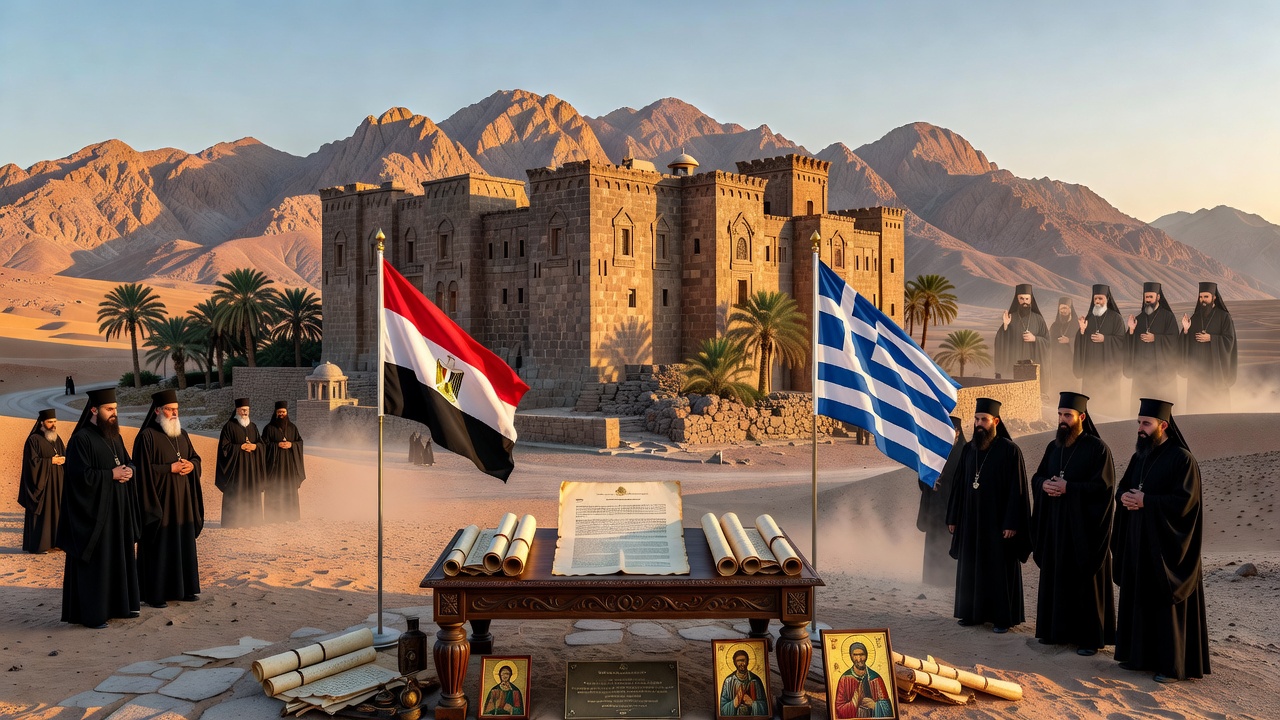
Egypt and Greece have finalized an agreement establishing a formal legal framework for the Holy Monastery of Saint Catherine on Mount Sinai, resolving a question of legal status that had persisted for roughly 1,500 years. The arrangement, announced by Greek officials, guarantees the preservation of the monastery's religious character and grants long-term residence permits to its resident monks.
What the Agreement Changes
For centuries, the Monastery of Saint Catherine - one of the oldest continuously operating Christian monasteries in the world - operated without a clearly codified legal foundation under Egyptian law, despite its historical and religious significance. According to Greek government officials, the new agreement with the Egyptian state addresses that gap directly. It is intended to protect, in perpetuity, the monastery's ecclesiastical properties and its religious identity, while also ensuring that its monastic community can continue to live and serve there through formal, long-term residency arrangements rather than informal or uncertain status.
Diplomatic Context and Religious Backing
Greek officials credited Egyptian President Abdel Fattah el-Sisi with personally facilitating the agreement, alongside Egypt's Foreign Minister, Badr Abdelatty. The deal is being framed by Athens as both a diplomatic achievement and a reflection of broader strategic and bilateral cooperation between Greece and Egypt. Notably, the agreement has received public backing from several major Orthodox Christian authorities, including the Ecumenical Patriarchate, the Patriarchate of Alexandria, the Patriarchate of Jerusalem, the Church of Cyprus and the Church of Greece - a rare instance of unified endorsement across multiple Orthodox jurisdictions on a single legal matter.
Why the Monastery Matters
Saint Catherine's Monastery sits at the base of Mount Sinai in Egypt and is recognized internationally for its historical manuscripts, religious art and continuous monastic life dating back to antiquity. Its legal ambiguity had long been viewed by religious and cultural observers as a vulnerability, given the site's importance to Orthodox Christianity and its status as a UNESCO World Heritage location. Formalizing residency rights and property protections is presented by Greek officials as a safeguard against future disputes over the site's use or status.
Limits of What Is Known
The announcement originates from Greek government statements, and full legal texts or implementation timelines from the Egyptian side have not been detailed in the available material. Questions such as the specific duration of residence permits, enforcement mechanisms, or how property boundaries are defined remain outside the scope of what has been publicly confirmed so far. As with any bilateral legal agreement, practical implementation will likely unfold over time through administrative and diplomatic channels in both countries.