
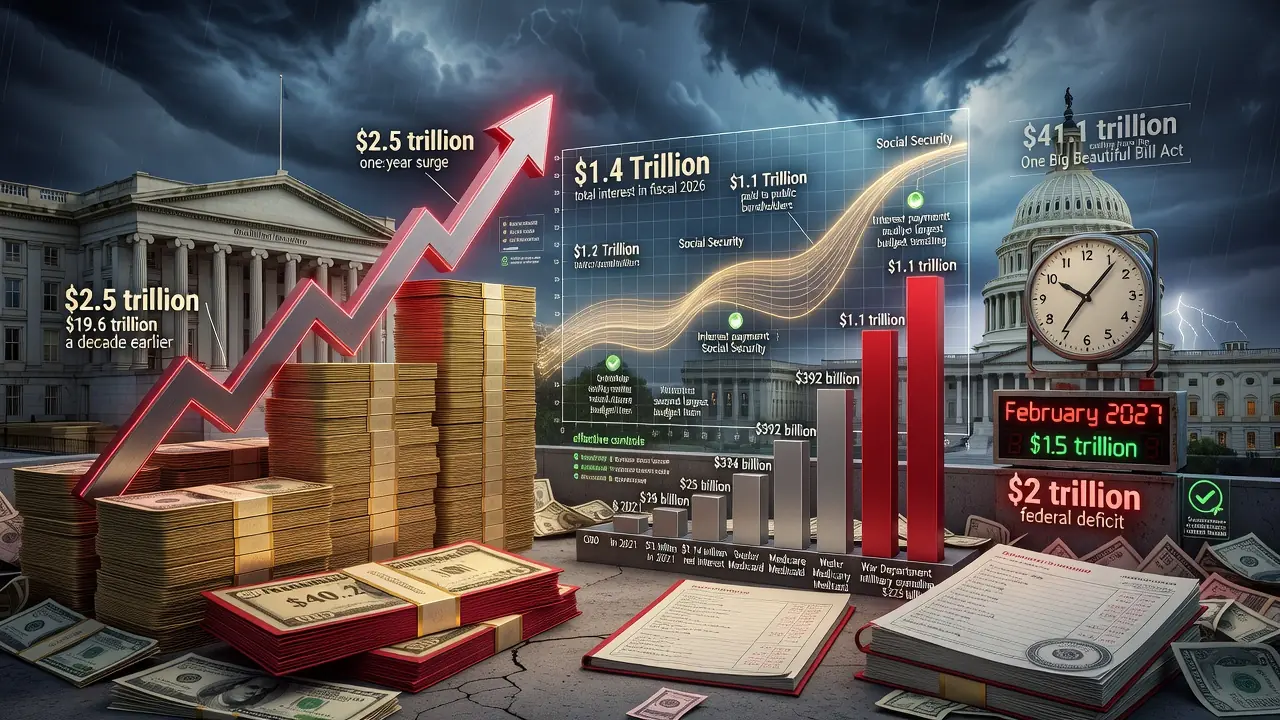
A new Government Accountability Office audit of Treasury's financial statements found that interest costs on the national debt reached $1.4 trillion in fiscal 2026, with total federal debt hitting $40.2 trillion as of September 30. The findings, combined with separate Congressional Budget Office data, show interest payments now rank among the largest items in the federal budget, trailing only Social Security.
What the audit found
GAO's review determined that Treasury's financial schedules were fairly presented and that its internal controls were effective. Of the $1.4 trillion in total interest costs, about $1.1 trillion went to bondholders who hold publicly traded Treasury securities, while the remainder was credited to federal trust funds - money the government essentially owes itself, such as the Social Security trust fund.
The $40.2 trillion debt total marks an increase of about $2.5 trillion in a single year and roughly double the $19.6 trillion owed a decade earlier. GAO traced much of the increase in debt held by the public to a persistent gap between federal spending and revenue.
Interest costs have risen sharply since 2021
The audit shows interest expense on debt held by the public climbed from about $392 billion in fiscal 2021 to roughly $1.1 trillion last year - nearly a threefold increase in five years. GAO attributed the surge to both a larger overall debt load and higher interest rates on newly issued and refinanced debt.
The Congressional Budget Office, using a related but distinct measure of net interest on the public debt, put the figure at $1.14 trillion for fiscal 2026, an 11% increase over the prior year. That sum exceeded what the federal government spent on Medicare or Medicaid and was about $225 billion more than the War Department's spending on military activities. CBO also reported the federal deficit at approximately $2 trillion for fiscal 2026, up from about $1.8 trillion the year before, with average annual deficits projected to exceed $2.4 trillion over the coming decade.
A debt-limit deadline looms next year
Matthew Dickerson of the National Taxpayers Union said he expects the government to reach its debt limit in February 2027, at which point Treasury would hold just under $1.5 trillion in cash and would need to rely on extraordinary accounting measures to continue meeting obligations. He projects those measures could be exhausted by late November 2027. Dickerson urged Congress to raise the debt ceiling during the current lame-duck session alongside spending reforms, rather than waiting until next year.
David Ditch of the Cato Institute noted that debt-limit votes have historically been one of the few moments Congress shows willingness to address deficits directly, suggesting lawmakers use the next vote to curb projected deficit growth. Separately, government funding under the continuing resolution signed in September is set to expire December 11, adding a nearer-term budget deadline. The Committee for a Responsible Federal Budget noted the current $41.1 trillion debt ceiling was set in July 2025 under the One Big Beautiful Bill Act, which raised the limit by $5 trillion.