
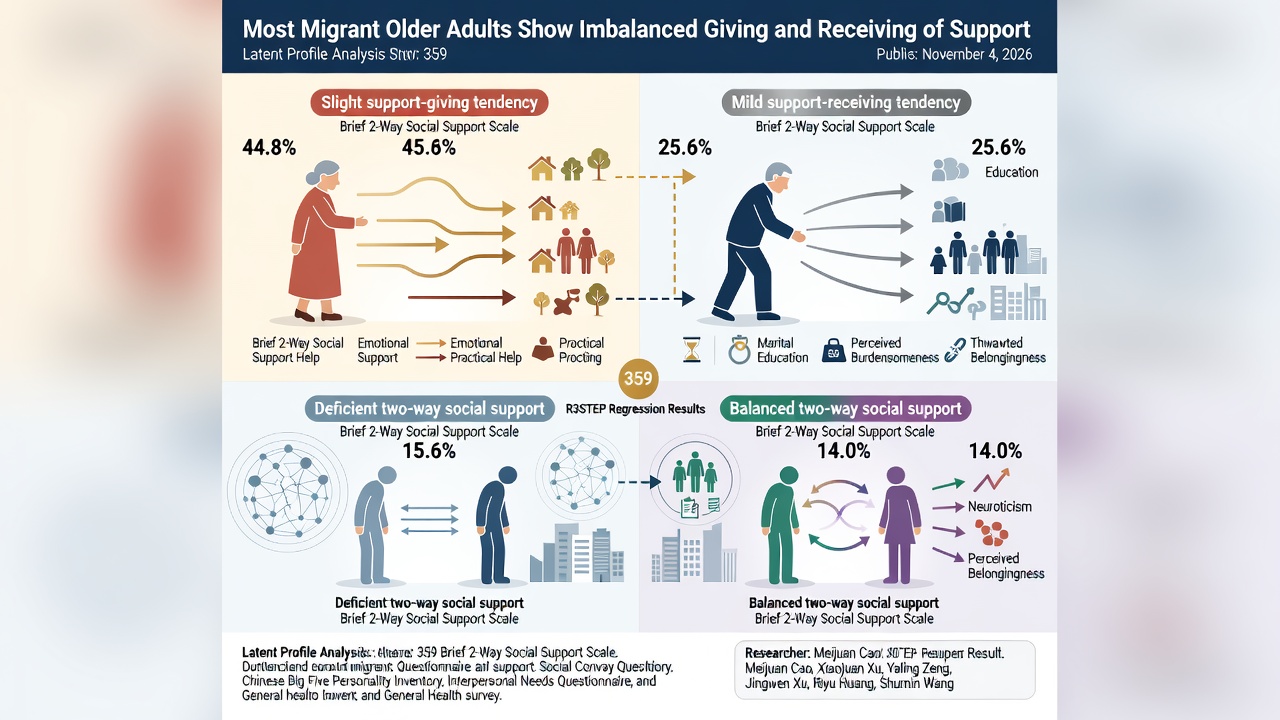
A new study of 359 migrant older adults found that balanced two-way social support-giving and receiving roughly equal amounts of help-is the exception rather than the rule. Published in BMC Public Health on November 4, 2026, the research identified four distinct support patterns among this population, with only 14% falling into the balanced category.
What the study measured
Researchers Meijuan Cao, Xiaojuan Xu, Yaling Zeng, Jingwen Xu, Riyu Huang, and Shumin Wang used a statistical method called latent profile analysis to sort participants into subgroups based on patterns in their survey responses. The team relied on several instruments, including the Brief 2-Way Social Support Scale, the Social Convoy Questionnaire, a Chinese version of the Big Five Personality Inventory, the Interpersonal Needs Questionnaire, and a general health survey. Unlike studies that look only at support received, this approach also tracked how much support participants gave to others, a distinction the authors say matters for understanding well-being in later life.
Four patterns of support exchange
The analysis sorted respondents into four groups:
- Slight support-giving tendency (44.8%): the largest group, giving somewhat more support than receiving.
- Mild support-receiving tendency (25.6%): leaning toward receiving more support than giving.
- Deficient two-way social support (15.6%): low levels of both giving and receiving.
- Balanced two-way social support (14.0%): roughly equal exchange in both directions.
Using a regression technique called R3STEP, the researchers found that age, marital status, education level, neuroticism, perceived burdensomeness, and thwarted belongingness were statistically associated with which profile a person fell into. These are psychological and demographic traits drawn from the personality and interpersonal-needs portions of the survey, not causal drivers-the study's cross-sectional design means it captures a single point in time rather than tracking change.
Why the distinction matters
Migrant older adults often experience disrupted social networks after relocation, which can affect their access to both practical and emotional support. By capturing both directions of exchange, the study suggests that an imbalance-whether leaning toward giving or receiving-is the typical experience for this population, rather than a mutual, balanced relationship. The authors note this heterogeneity could help inform more targeted interventions aimed at fostering healthier, more reciprocal support networks as part of broader healthy-aging efforts.
Limits of the findings
The study describes associations, not causes, and the results apply to the specific sample of 359 participants studied. The article was shared as an open-access early version with a permanent DOI, ahead of further edits before a final published version. Researchers caution that the identified profiles offer a framework for further study rather than definitive conclusions about why these patterns occur.