
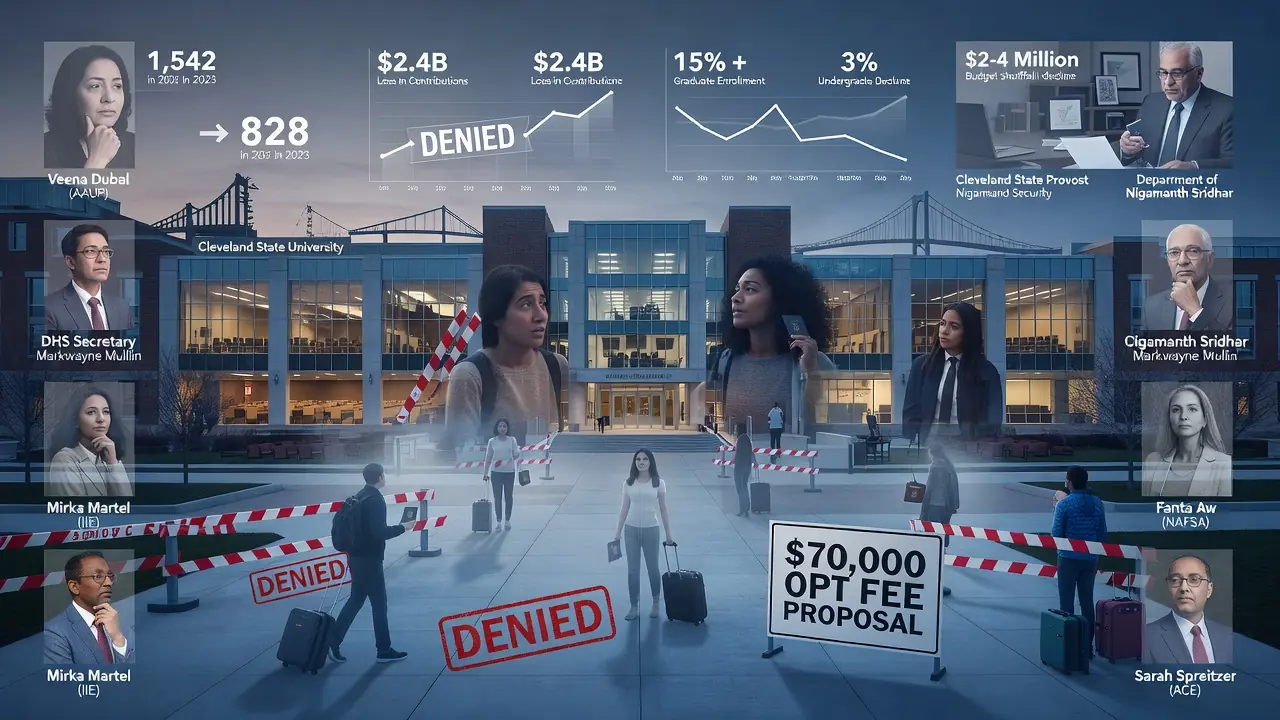
New data released Monday by the Institute of International Education show U.S. campuses enrolled 9% fewer international students this fall than last year, with first-time foreign enrollment down 15%. College leaders and immigration advocates link the decline to tightened visa processing, travel restrictions and a proposed federal fee tied to post-graduation work programs under the Trump administration.
What the survey found
The IIE survey, covering more than 800 U.S. colleges and universities, found that graduate-level international enrollment fell 15%, far steeper than the 3% drop at the undergraduate level. Enrollment from India, historically the largest source of international students in the U.S., also declined. Participation in Optional Practical Training (OPT), the program allowing international graduates to work temporarily in the U.S., dropped 6% this fall after the Department of Homeland Security proposed charging schools $70,000 for each OPT participant. That rule has not been finalized but is already shaping decisions, according to the survey.
Separately, NAFSA, an association representing international educators, estimated - with technology partner JB International - that international students' contributions to the U.S. economy fell by $2.4 billion this fall compared with the prior year.
Policy changes cited by colleges
Among surveyed institutions, 88% pointed to the visa application process and 70% cited travel restrictions as reasons for enrollment declines. This summer, DHS finalized a rule limiting international students to four years in the U.S. without federal approval, though a judge has temporarily blocked its enforcement. DHS Secretary Markwayne Mullin has said the changes target loopholes some students used to extend their stays. The department has also terminated the legal status of thousands of international students and pursued detentions and deportations, actions that are part of the broader immigration enforcement context described in the survey.
Veena Dubal, general counsel for the American Association of University Professors, said the cumulative effect has reshaped how families abroad view studying in the U.S. "It feels like an unsafe place," she said, describing a message she believes is reaching prospective students worldwide.
Financial strain and competing destinations
Some campuses are already absorbing the fiscal impact. Cleveland State University reported a 46% drop in international enrollment over two years, from 1,542 students in fall 2023 to 828 this fall, with fewer than 50 new international students arriving this term. Provost Nigamanth Sridhar estimated the budget impact at $2 million to $4 million.
Mirka Martel of the IIE said politics is not the only factor; rising U.S. tuition costs and growing competition from other countries are also pulling students elsewhere. Fanta Aw of NAFSA said uncertainty over research funding is another concern, noting some students are choosing to study in China instead.
What happens next
Sarah Spreitzer of the American Council on Education said major immigration legislation is unlikely while Trump remains in office, but she said congressional oversight could still slow further policy changes affecting international students, potentially offering more predictability. The DHS fee proposal is expected to face legal challenges before any final rule takes effect, and full-year enrollment data will not be available until next year's report.